

Introduction
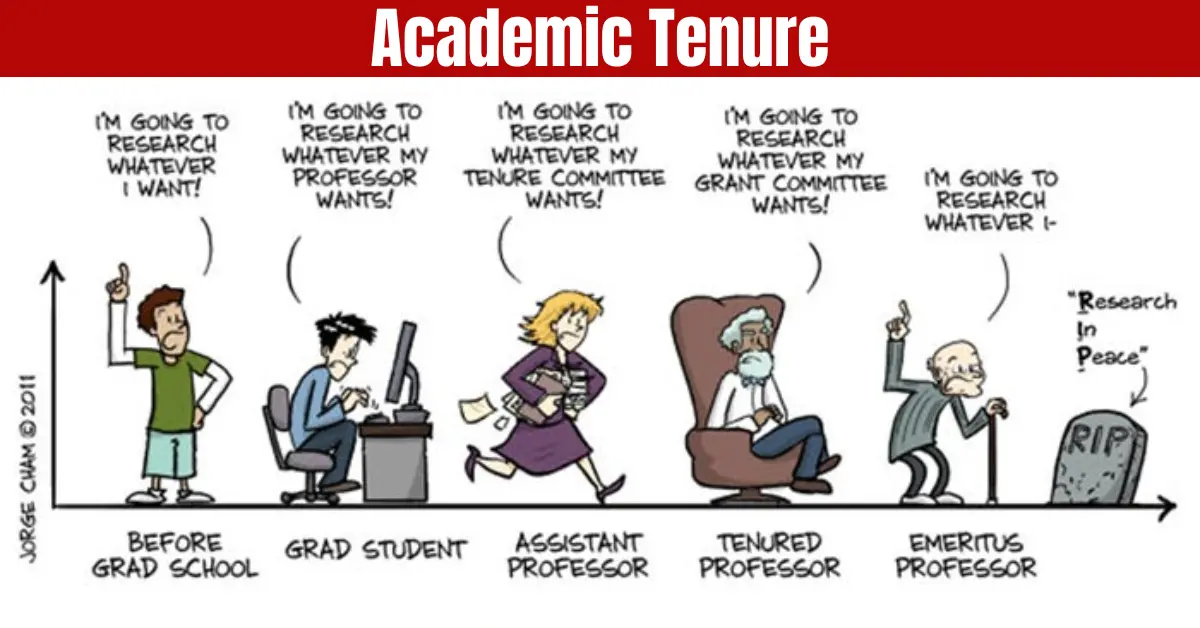
Academic tenure is a long-term employment status granted to professors that protects their academic freedom and ensures job stability within the higher education system. In simple terms, academic tenure means a faculty member has demonstrated excellence in teaching, research, and service — enough to earn a permanent position at their institution.
Most professors begin their journey as tenure-track faculty, working through several years of evaluation before undergoing a formal tenure review. This review examines their research contributions, teaching effectiveness, and overall impact on the university community.
Today, academic tenure matters more than ever. As universities face financial pressures, political scrutiny, and rapid changes in teaching and research expectations, tenure provides scholars with the independence they need to explore new ideas, conduct meaningful research, and challenge established norms without fear of losing their jobs. It remains a cornerstone of academic freedom and a defining feature of strong, innovative universities.
What Is Academic Tenure?

Academic tenure is a formal status granted to faculty members that provides long-term job security and protects their ability to pursue research and teaching without external pressure. In essence, it ensures that scholars can investigate complex, controversial, or innovative ideas without fear of being dismissed for political, institutional, or public disagreement.
Tenure has deep historical roots in the higher education system, originating as a safeguard for academic freedom. Over time, it has evolved into a structured process that balances faculty independence with institutional accountability. When a professor earns tenure, it signifies that they have met high standards in scholarship, teaching, and service — and that the institution acknowledges their long-term value.
Universities widely view tenure as a commitment to intellectual rigor and stability. It helps attract and retain talented scholars, fosters a culture of research excellence, and supports the free exchange of ideas that drives academic progress.
How the Academic Tenure Process Works
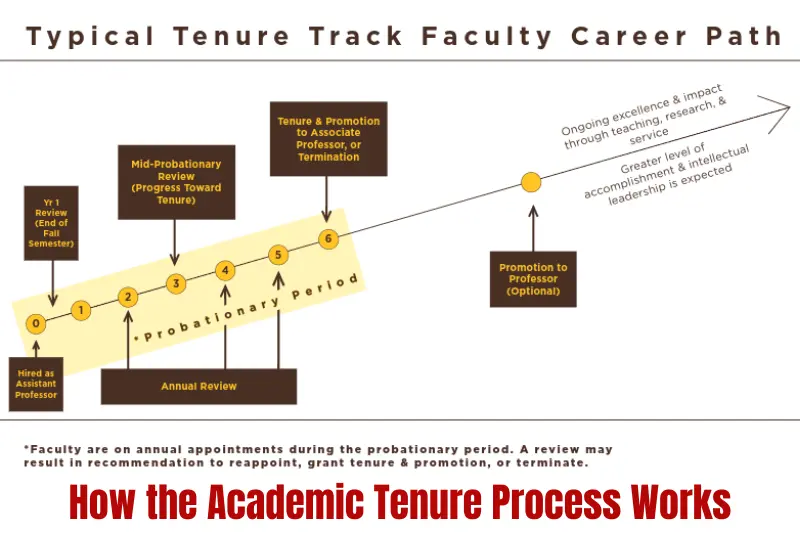
The academic tenure process is a multi-year evaluation designed to determine whether a faculty member has demonstrated the excellence, consistency, and potential required for a permanent position. Although the specifics vary across institutions, most universities follow a similar structure that includes probationary years, ongoing evaluations, and a comprehensive tenure review.
Tenure-Track Positions
Most professors begin on a tenure-track appointment, typically as assistant professors. This period usually lasts five to seven years and serves as a probationary phase during which faculty members must build a strong record in three key areas:
- Teaching: delivering high-quality instruction, developing courses, and demonstrating positive student outcomes.
- Research: producing scholarly publications, securing grants, and contributing to their field.
- Service: participating in committees, mentoring students, and supporting departmental and institutional initiatives.
Successful tenure-track faculty are expected to maintain a balanced portfolio that demonstrates long-term promise and commitment.
Evaluation Criteria
Throughout the tenure-track period, universities evaluate faculty performance using several criteria:
Teaching Effectiveness
Institutions often review student evaluations, teaching portfolios, peer observations, and curriculum development. Demonstrating sustained improvement and innovation in teaching is essential.
Research and Scholarship
Publications in reputable journals, books, presentations, citations, and external grants all play a significant role. The quality, originality, and impact of research often weigh more heavily than quantity.
Service and Engagement
Faculty members contribute to the university through committee work, academic advising, community outreach, and professional service in their discipline. This demonstrates a commitment to the institution beyond the classroom.
The Tenure Review Process
At the end of the probationary period, the faculty member undergoes a comprehensive tenure review. This typically includes:
- A tenure dossier: A detailed portfolio containing publications, teaching evaluations, service records, and a personal statement.
- Internal review: A department or college-level tenure committee evaluates the faculty member’s contributions and makes a recommendation.
- External review: Independent scholars in the field assess the candidate’s research impact and reputation.
- Administrative approval: Deans, provosts, and sometimes the board of trustees make the final decision.
If approved, the faculty member is promoted—often to associate professor—and granted the long-term job security associated with tenure.
Benefits of Academic Tenure
Academic tenure offers several important benefits that shape the culture, productivity, and long-term stability of the higher education system. These advantages extend not only to individual faculty members but also to universities, students, and society as a whole.
Job Security
One of the most widely recognized benefits of academic tenure is long-term employment stability.
Once a professor earns tenure, they cannot be dismissed without just cause, which protects them from:
- sudden budget cuts
- administrative changes
- political or ideological pressures
- retaliation for unpopular research findings or public statements
This stability allows faculty to focus on long-term projects rather than short-term job survival.
Academic Freedom
Tenure plays a crucial role in preserving academic freedom — the ability of scholars to research, publish, and teach ideas without fear of censorship or professional retaliation.
This protection encourages:
- independent thinking
- bold, innovative research
- critical discussions on sensitive or controversial topics
In essence, tenure ensures that higher education remains a space where knowledge can develop without undue control.
Attraction and Retention of Talent
Universities use tenure as a tool to attract and retain highly skilled faculty.
Tenure signals that an institution values:
- long-term intellectual contributions
- research excellence
- sustained teaching quality
It also makes universities more competitive when recruiting scholars who seek stable, supportive environments for deep academic work.
Supports Long-Term Research
Many research projects — especially in science, the humanities, and social sciences — require years of sustained investigation.
Tenure gives faculty the freedom to commit to long-term studies that may not yield immediate results but have significant long-term impact.
This kind of research is essential for advancing knowledge, influencing policy, and solving complex problems.
Challenges and Criticisms of the Tenure System
While academic tenure provides many benefits, it also faces significant criticism. Universities, policymakers, and even faculty members have raised concerns about how the system operates and whether it still aligns with the evolving needs of modern higher education.
Rigid Employment Structures
Tenure can make it difficult for universities to adapt their workforce quickly. Because tenured positions are long-term commitments, institutions may struggle with:
- replacing underperforming faculty
- updating departments to match new academic trends
- reallocating budgets toward emerging fields
This rigidity can limit institutional flexibility and slow organizational change.
Pressure on Early-Career Scholars
The tenure-track period is often described as “publish or perish.”
During these probationary years, faculty face intense pressure to:
- publish frequently
- obtain grants
- excel in teaching
- participate in service roles
This workload can lead to stress, burnout, and challenges maintaining a healthy work-life balance.
Financial Constraints for Universities
Granting tenure represents a long-term financial commitment for universities. This can be challenging during times of:
- budget cuts
- declining enrollment
- reduced state funding
To manage costs, many institutions increasingly rely on non-tenure-track faculty, which raises concerns about fairness and instructional quality.
Equity and Diversity Concerns
Critics argue that the tenure review process can inadvertently reinforce inequities. Common issues include:
- implicit bias in evaluating candidates
- fewer opportunities for women, minorities, and first-generation scholars
- uneven access to mentorship or research resources
This has sparked calls for greater transparency, diversity initiatives, and reforms that support more inclusive academic career pathways.
Alternatives to Traditional Academic Tenure
As the landscape of higher education shifts, many institutions are exploring or adopting alternatives to the traditional tenure system. These models aim to balance instructional quality, institutional flexibility, and financial sustainability while still supporting faculty development.
Non-Tenure-Track Faculty Positions
Many universities rely on non-tenure-track or teaching-focused positions. These roles include titles such as:
- Lecturer
- Senior Lecturer
- Teaching Professor
- Clinical Professor
These faculty members often have renewable contracts rather than permanent appointments. While they may not receive the same protections as tenured faculty, these roles offer:
- more stability than adjunct positions
- clear promotional pathways
- a stronger focus on teaching and student engagement
Adjunct and Part-Time Faculty
Adjunct faculty are hired on a course-by-course basis, offering institutions maximum flexibility.
However, adjunct roles come with challenges:
- low pay
- limited job security
- minimal access to benefits
- limited involvement in departmental decision-making
Despite these drawbacks, adjuncts allow universities to fill instructional gaps quickly and cost-effectively.
Contract-Based Systems
Some institutions use multi-year contracts to provide stability without granting full tenure. These contracts can last anywhere from three to seven years and may include periodic performance reviews. They offer:
- more accountability
- reduced long-term financial commitments
- structured opportunities for renewal or advancement
This model is commonly used in community colleges and professional schools.
Teaching-Only or Research-Only Tracks
Certain universities create specialized tracks where faculty commit primarily to one area:
- Teaching-only tracks focus on instructional excellence and student mentoring.
- Research-only tracks emphasize grant-funded research and scholarly productivity.
These paths allow faculty to excel in their strengths without being judged equally across teaching, research, and service.
Hybrid or Revised Tenure Models
Some institutions are experimenting with modernized tenure systems that include:
- periodic post-tenure reviews
- flexible evaluation criteria
- greater emphasis on interdisciplinary work
- more transparent processes
These reforms aim to preserve academic freedom while addressing common criticisms of traditional tenure.
The Future of Academic Tenure in Higher Education
The future of academic tenure is the subject of ongoing debate as universities navigate financial pressures, shifting student needs, and rapid changes in research and technology. While tenure remains a defining element of academic life, its structure and purpose may evolve significantly in the coming years.
Increasing Calls for Reform
Many experts and policymakers argue that traditional tenure needs modernization. Current reform discussions focus on:
- improving transparency in the review process
- addressing inequities and bias
- increasing accountability through post-tenure reviews
- balancing research excellence with teaching effectiveness
These proposed reforms aim to strengthen tenure rather than eliminate it.
Growth of Non-Tenure-Track Roles
As higher education budgets tighten, universities are increasingly relying on non-tenure-track faculty. This trend is likely to continue, raising key questions about:
- long-term instructional quality
- faculty morale and job security
- equity between tenure-track and non-tenure-track educators
The future may include a more diverse mix of faculty roles across institutions.
Evolving Expectations for Faculty
The responsibilities of academic faculty are changing. New expectations include:
- digital teaching skills
- interdisciplinary collaboration
- community engagement
- securing external funding
Future tenure models may incorporate these elements more explicitly into their criteria.
Impact of Technology and AI
Advances in technology — including AI-driven research tools and digital learning platforms — are reshaping academic work. Their impact may lead to:
- shifts in research evaluation
- new forms of scholarly output
- updated definitions of teaching quality
Institutions may need to adapt tenure standards to reflect these evolving realities.
Continued Importance of Academic Freedom
Despite the pressures facing higher education, academic freedom remains essential. As societal polarization increases, the role of tenure in protecting scholarly independence will likely remain a core justification for its continuation.
Ultimately, the future of academic tenure is not about whether it will disappear, but how it will adapt. Its evolution will depend on how universities balance faculty autonomy, financial sustainability, and their commitment to educational excellence.
Conclusion
Academic tenure remains one of the most influential and debated features of the higher education system. At its core, tenure is designed to safeguard academic freedom, encourage rigorous scholarship, and provide faculty with the long-term stability needed to pursue meaningful work. While the system has undeniable strengths — including job security, research independence, and talent retention — it also faces significant challenges related to equity, financial sustainability, and institutional flexibility.
As universities evolve in response to technological change, shifting student expectations, and budget pressures, the tenure model will likely continue to adapt. Whether through reformed evaluation standards, expanded non-tenure-track options, or hybrid models that blend accountability with autonomy, the future of tenure will reflect the changing landscape of academia itself.
What remains constant is the value of a system that empowers scholars to explore ideas freely, contribute to public knowledge, and shape the future of their fields. Academic tenure, in whatever form it takes moving forward, will continue to play a vital role in supporting the mission of higher education.
